Authentication in the field of art is not an exact science!

26.12.2018

Most of the fakes go to the market at the very bottom of the food chain: flea markets, thrift stores and online websites such as eBay.

An expert verifies the authenticity of the exhibits at the TEFAF Old Art Fair in Maastricht. Photo: Loraine Bowdewes / Tefaf

Jane Kallir. Curator, art historian, author of the rationality of Egon Schiele

The procedure for establishing the authenticity of works of art has recently been attacked from all sides. Fake scandals flare up one after another. Just a few months after the German court convicted Wolfgang Beltrakki of counterfeiting the works of Heinrich Kampendonk, Max Pechstein and Max Ernst, one of America’s oldest galleries, Knoedler, closed in the US, accused of selling fake works of art attributed to leading representatives abstract expressionism. In the summer of 2017, the exhibition Amedeo Modigliani at the Doge’s Palace in Genoa closed ahead of time after it became clear that almost all of its exhibits are fakes. (A year ago, another scandal began around the dubious Russian avant-garde, presented at the Ghent Museum of Fine Arts, while far from complete. In recent years, fearing legal proceedings, funds representing the legacy of artists such as Jean-Michel Basquiat, Alexander Calder, Lee Krasner, Roy Lichtenstein, Jackson Pollock, Andy Warhol and Keith Haring dismissed their expert commissions, when they are most needed, experts begin to be overly cautious.

Nevertheless, the scale of the attribution crisis is not at all as large as it may seem, judging by the above-mentioned high-profile cases. Most of the fakes go to the market at the very bottom of the food chain: flea markets, thrift stores, and online sites like eBay. Such cheap fakes, as a rule, are revealed even before they manage to penetrate the upper segment of the art market. Very few manufacturers of fakes have enough talent for creating original compositions that are close stylistically to the works of eminent artists in order to mislead a relatively knowledgeable person, not to mention experts.

However, as the cases of Beltrak and Knoedler show, if the fake manufacturer still manages to break through the defense of the artistic community, we can talk about huge stakes. Restorer and scientist James Martin, who was able to expose the fake Knoedler, proving that the creation of paintings was used are not characteristic of artists anachronistic materials, likes to compare attribution with a stool, standing on three legs: fame, technical analysis, and provenance. Systematic study and cataloging help to identify the individual stylistic features of each artist and streamline knowledge about who and when belonged to his work.

Despite the fact that provenance is a useful addition to the material evidence that can be obtained by analyzing the materials from which the work of art is made, it is not enough to establish authorship. The history of origin is easy to falsify, and the fakes have penetrated into the collections of many prominent collectors. Similarly, the discovery of pigments unknown during the artist’s life may serve as proof of a fake, but the presence of substances corresponding to historical realities does not necessarily prove authenticity. For all the importance of technical analysis and provenance, a key role in attribution is played by knowledge.

Establishing the authenticity of works of art is not and, apparently, will never become an exact science. This does not mean that specialists working in this field are incompetent or inconsistent. Nevertheless, we live in a world of “alternative facts”, where all opinions are considered equally weighty and where everyone can find an “authoritative person” who will express the judgment he needs. At the heart of the current attribution, the crisis is a combination of populist discontent with the very phenomenon of expertise, the inevitable subjectivity of the attribution procedure and dizzying prices for art.
 

Picture of Kerry James Marshall “Knowledge and miracle” will return to people

17.12.2018

Picture of Kerry James Marshall, created for the City Library of Chicago, was removed from the auction Christie’s.

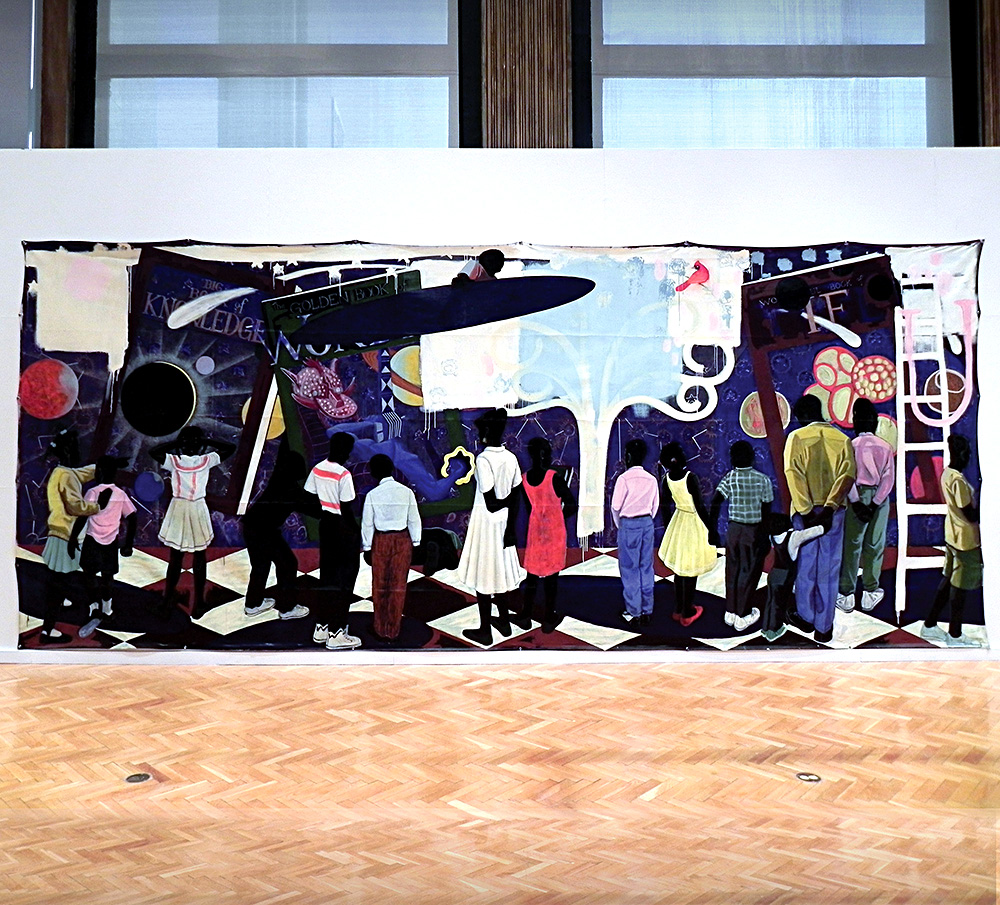
Kerry James Marshall. “Knowledge and miracle.” 1993. Photo: Christie’s

The municipality of Chicago has deliberated on putting out the monumental work of the African American Kerry James Marshall “Knowledge and Miracle” for the November New York auction of Christie’s. The lower estimate of work was $ 10 million, and the proceeds were planned to be spent on expanding the Lehrer Library, for which it was created in 1993.

However, plans to sell the product caused outrage of the public and Marshall himself, who told Artnews that the Chicago administration “squeezed every last drop out of the fruits of his work.” Last year, the artist sold one of her works to the city for a symbolic $ 1, and at the beginning of this year, the state company that manages the McCormick Place exhibition center decided to sell Marshall’s work “Old Times”, and in May she left for Sotheby’s in New York record $ 21.1 million

However, Chicago Mayor Ram Emanuel abruptly changed his mind to sell “Knowledge and Miracle.” What the Chicago Tribune admitted: “I realized that I don’t want this, especially considering the city’s contribution to the development of public art and the fact that Kerry is not only our friend but also an eminent representative of Chicago. I contacted him and said: “Listen, I do not want to sell it. If you are unhappy, I’d rather cancel everything. ”

Christie’s published a press release in which it stated that the work depicting black children looking at giant illustrated books on space was withdrawn “by mutual agreement” with the Chicago authorities.
The statement also says that Christie’s “has no doubts that this masterpiece is of great interest in the market,” and at the same time emphasizes that the auction house “actively supports” the development of public art.
“All parties are pleased that Kerry James Marshall’s Knowledge and Miracle will remain in Chicago. Both the city administration and Christie’s really wanted the product to not leave the city as a result of the bidding, and that’s what we’ve been working on for the last few weeks, ”the statement of the auction house stresses. According to the agency Bloomberg, the work will return to its former place in the library.

An exhibition of Anatoly Kryvolap will open in the Kiev museum.

10.12.2018

The personal exhibition of the most expensive Ukrainian artist Anatoly Kryvolap will open on December 13 at the Museum of the History of Kyiv, with the support of the Savings Bank, which will last until January 19, 2019.

Anatoliy Kryvolap for a long time leads the rating of the most successful Ukrainian artists. From 2010 to 2015 at the world and domestic auctions sold 18 of his paintings for a total of $ 771 180. Of which $ 121,343 – for the canvas “Horse. Night “, which sold the Phillips auction house in London in 2011. And in 2013, another picture from this series “Horse. Evening “went for a record amount at the same auction for $ 186,200. Anatoliy Kryvolap’s works are included in almost all the collections of the most famous Ukrainian contemporary art collectors.

According to representatives of the state financial institution, Oschadbank consistently supports and promotes Ukrainian art.

“This exhibition is the next step in cooperation between our bank and Mr. Anatoly. So, premium premium premium premium.oschadbank.ua we have decorated in the style of an online art gallery. An exhibition of paintings by Anatoly Dmitrievich is shown first on the website. A separate part of the site is called “Picture Gallery”. There you can not only look at the masterpieces of Ukrainian fine art but also consult on their acquisition “, – said in a message the manager of the bank.

Source: https://ukraineartnews.com/news/expo/u-kijivskomu-muzeji-vidkrivajetsja-vistavka-anatolija-krivolapa

Today on SOTHEBY’S sell a picture of Rembrandt with the fingerprints of the artist.

05.12.2018

The Sotheby’s auction house reported that on December 5, 2018, a unique portrait of the Dutch painter Rembrandt would be put up for sale: the artist’s fingerprints could have been preserved.

The representative of Sotheby’s, George Gordon, said that the prints were discovered during the examination and recovery a few years ago, in the painting “Study of a Head of a Young Man”, reports the Associated Press.

The picture depicting the Head of Christ is a quickly drawn oil sketch on an oak panel.

At the same time, Gordon noted that the experts cannot be “100% sure” that the prints belong to Rembrandt, but they certainly belong to someone who took the picture as soon as it was finished. “Detection of marks in the original paint layer … makes their connection with the artist very likely,” he added.

Michel Van de Laar, who first noticed fingerprints together with researcher Ari Wallert, said that the picture was completed in one session, using a practice that involves the rapid application of paints and layers. This method could only be used by a qualified craftsman, as there is a risk of smearing the drawing.
“The opening of the fingerprints is another indication of the speed with which the work was done, and provides up-to-date information about the sophisticated, but the fast, drawing technique of Rembrandt,” added Van de Laar.

Sotheby’s said that the picture will be posted for sale in London on December 5, with an estimated value of 6 million pounds (7.7 million dollars).

This will be the first appearance of this painting, painted about 400 years ago, on the art market in the last 60 years.

How to choose a picture for the interior?

28.11.2018

Every year more and more housing is built in the country. And this means that thousands of our citizens will move into new houses and apartments, will do repairs, furnish interiors, select appropriate paintings, photos, posters on the walls. After all, how can it be without such an important and catchy element of apartment décor as paintings? Mono paintings, modular paintings, photo paintings, and any images made on the basis of their own sketches, or copies of the canvases of the world’s greatest artists, can be undoubtedly found on the walls of future “cloisters of warmth and comfort.” And here we will stop and make a short pause on the important and useful, from our point of view, information, for the sake of which this article was written. Since you decided to decorate your home with a new picture, then let’s figure out what it should be, so that not only “covered a hole in the wall”, but also organically fit into the interior of the rooms and constantly delight the demanding views of the hosts and guests.

So, we will single out three main parameters, on which it is desirable to be oriented when choosing paintings in our own apartments and offices. And it will be the plot, color and size of your future quad chosen.
There are no comrades on the plot and color? 
We can say that the ideal is a combination of the interior of your room, plot, color, and the size of the picture, too. It is possible to say, but it is more difficult to perform. Of course, if you are a very prudent and artistically advanced person, or you have ordered not just a repair team, but an experienced design studio, the repair and interior of your apartment (office), all of the following will be taken into account at the design stage and previously agreed with you. But, alas, often acquired paintings are already “customized” for the finished interior. And even the interior is corrected for pre-purchased canvases. To minimize or level out such situations, we give you some tips:
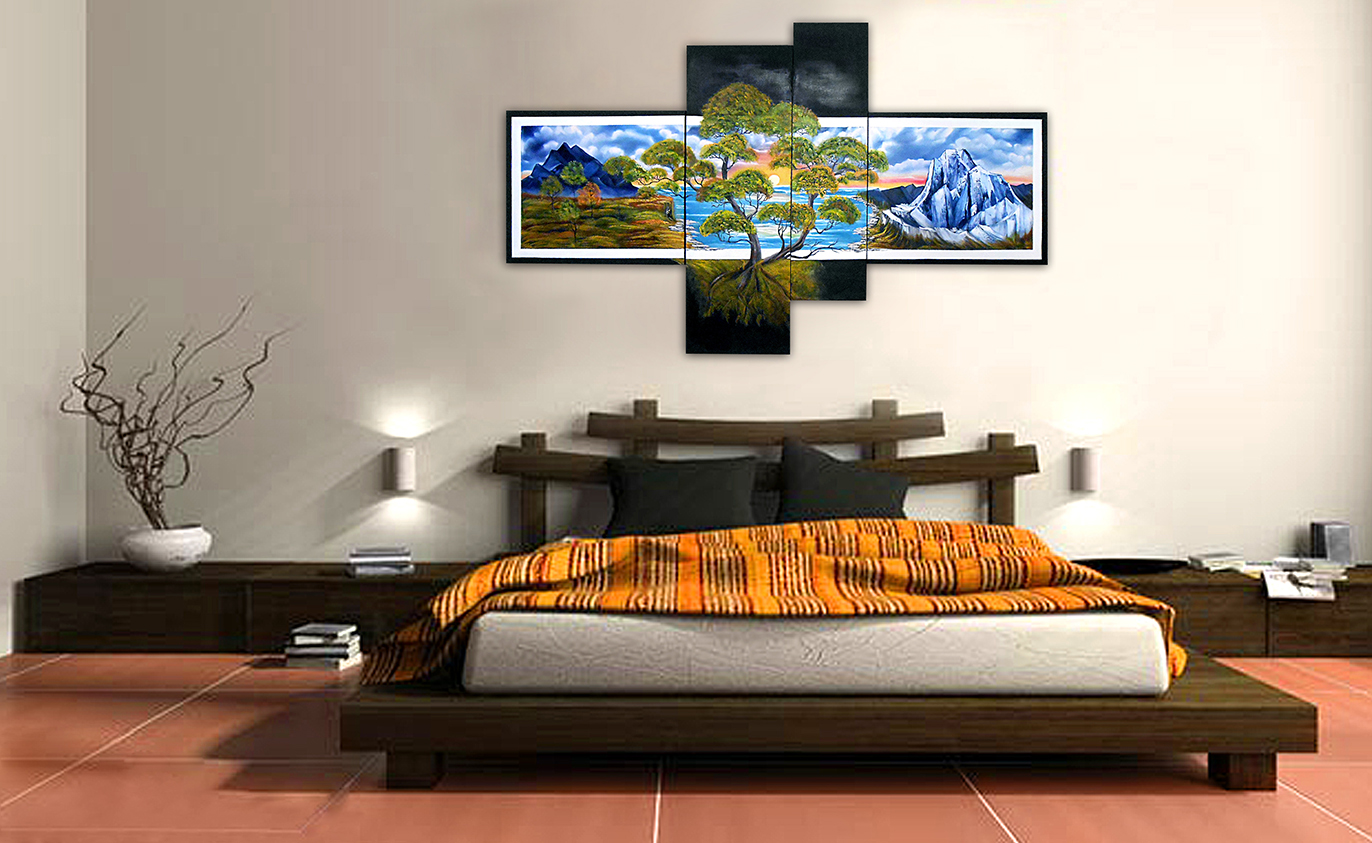
1. If you need to put one thing at the forefront, we would advise you to make the style and meaning of the picture basic, of course, if you have a room in one strict subject. Sacrifice color so that the spirit and mood of the decor are respected. We explain for example. Suppose you close oriental style, say, Chinese motifs. And your room is decorated in such calm and subtle tones. Perhaps, wallpaper with bamboo shoots or ancient Chinese pagodas is stuck. The entourage is appropriately matched – mats, sets for tea ceremonies, etc. Obviously, Shishkin’s The Morning in a Pine Forest or The Last Supper by Leonardo cannot be placed in such a specific atmosphere! Yes, even seemingly neutral portraits we do not recommend hanging here since even they will look alien in such an interior. But the pictures like “The branch of blossoming almond” or something from the eastern graphic (nature with animals, birds and beautifully written hieroglyphs) will fit in here organically and absolutely will convey the right mood and conceived atmosphere.
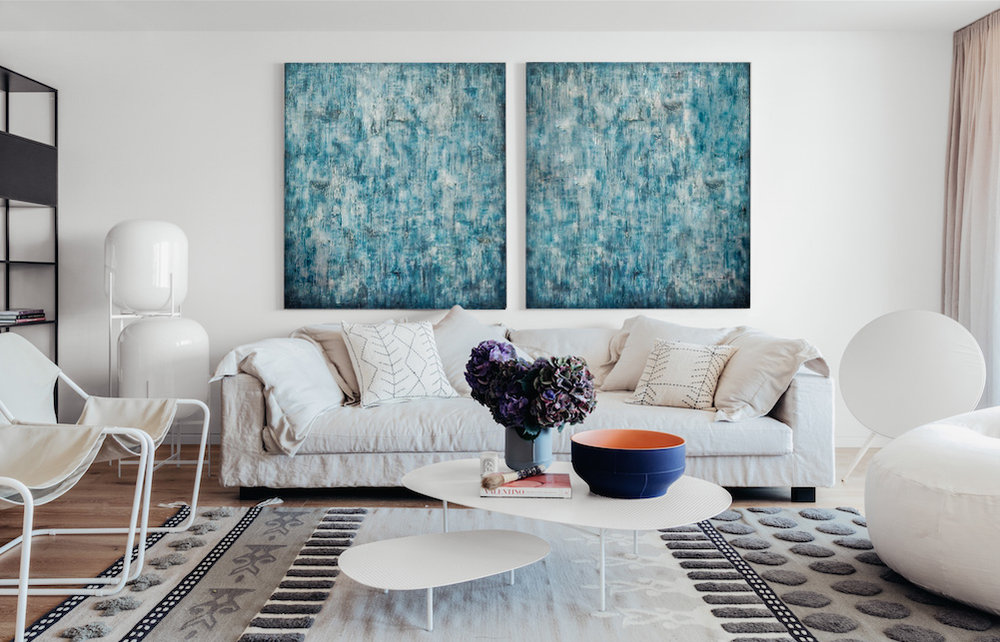
2. If your living room, children’s room or office is not decorated in a clear style theme, then the color of the picture may become the dominant factor, and the drawing or plot on it, strange as it sounds, may be secondary. Color as a way of expressing moods and ideas — this is the task of such a mono picture, a modular picture or even a series of pictures. And, remember, in this situation, the picture can organically fit into the interior, being, as it were, its continuation by other means, without getting out of the general canvas of its color plot. It will be a continuation and addition of the entourage and gently, without particularly concentrating on itself, will deprive the wall of emptiness and loneliness.
3. Or maybe your canvas, on the contrary, will be a catchy and eye-catching color spot or even a whole range of colors, with one bright and attractive color scheme prevailing in it. And now the interior becomes as if subordinate to the chosen picture, and under it, the small interior additions are selected, which overlap with its palette. For example, it may be the same tone sofa cushions. Or a rug under the table. Or a vase on the nightstand. Or lamp shade. And as the style of such “color pictures-anchors”, canvases in abstract style or large-pictured flowers are well suited (especially for paintings in modular design).

Give my favorite picture size!

And a few recommendations regarding the size of the paintings. This is not only and not so much the cost of the future canvas, as the organic perception of its image. It is also a very important parameter that can seriously affect the harmony of the interior.
1. Choose for yourself the dimensions of the picture as you choose the size of the TV, when the main thing is to see well and comfortably what is happening on the screen. The same should be with the picture, which must be clearly measured with the squared room, the height of the ceiling and the decor in the room. And note that the desired distance from the picture to the potential point of view should be not less than the sum of its two diagonals.

2. Yes, there is a so-called “knock-down scale” method among designers – large in small, small in large. But to apply this technique must be very carefully and carefully, and only having a good taste and design vision. After all, very rarely and exclusively in a certain entourage are small canvases or photographs on huge walls not looking dull and lonely. Or too large posters in small and cluttered rooms will look good and be adequately perceived. Therefore, all the same, it is better when the walls, despite the presence of pictures on them, will be enough “air” and the possibility of “breathing”.
3. And never forget about the geometry of paintings or photo canvas. It is also important for the general perception of the space of the rooms since the vertically oriented paintings make the ceiling of your room as if visually higher, and the indoor space is more. Modular pictures that can not only be divided into the number of modules required for an interior with any dimensions in width and height but also vary the location of the modules themselves relative to each other, that is, actually build their own original canvas, are particularly well suited to create a visual effect!

Yourself Hermitage

Well, the last recommendation, which does not cancel all previous ones, but complements them. If it so happened that your life rule – no rules, then do not really pay attention to our article and recommendations, and buy pictures of any colors, scenes and configurations, as long as you like. In the end, there is a universal answer from disgruntled artists, creators, and other creative natures: “I see this.” And you can always use this advice and statement. Good pictures to you and unmatched interior!

Source: http://art-news.com.ua/kak-podobrat-kartinu-k-intereru-20116.html
© Art News Ukraine. Under the guidance of Sotheby’s.

Lena Votkalenko – amateur and nugget

16.11.2018

Nowadays there are so many talented artists that it is incredibly difficult to single out one or two, and at the same time, they are all professional in their creation. But still, there are exceptions – these are nuggets, amateurs. They draw on a whim, sometimes breaking all the canons of academic art and, nevertheless, attract us with their inexplicable charm and individual handwriting in the paintings. We suggest to you also get acquainted with such an artist – Lena Votkalenko, she is an economist by profession and an artist by mission, besides, a wonderful and responsible mother of two children. Her works are always different, unusual, surprising and definitely inspire optimism. She told us about her creative activity in the interview.

  1. Who in your family needs to be thanked for the talent?

The only one person who could masterfully draw in our family was my grandfather on my mother’s side. He was also not a professional artist, but this did not prevent him from creating beautiful paintings. Essentially, he painted village landscapes and scenes of everyday life of the villagers. The wooden canvas was used as a canvas because another material was not available to him at that time. I believe that my grandfather was very talented, he painted better than I did, and if he had developed his ability, he could have become an outstanding Ukrainian artist. Therefore, I think that I should thank him for his ability to draw.

  1. In what manner did your grandfather write? Is there something similar in your paintings?

If we talk about similarity, only the topic unites me with my grandfather: I, like him, love to draw nature and everything connected with it. Otherwise, our creativity does not coincide, in many respects, it is connected, most likely, with the time of birth, place and living conditions. I love the experiment in the field of forms, so I use different methods and techniques characteristic of modern art. I like the expression in the picture, bright, pure colors, non-standard execution. Because nowadays, academicism will surprise no one.

  1. Can you divide your work into periods that are radically different from each other?

Yes, but I would divide it not by direction or style, but by purpose. In my youth, I didn’t have a goal to become an artist, so I painted from time to time, depending on my mood and desire. Now I have another goal – to reveal myself as an artist, to show my work to society not only in Ukraine but also abroad.

  1. Who / what inspires you?

Inspiration lives with me always and ideas of drawings live in my head with a margin. Painting is the melody of my soul and way of life. Inspiration comes when a person is freed from everyday life and vanity to those who have pure thoughts and a bright head when you are ready for inspiration, for constant work and believe in yourself.

  1. How do you determine in what manner and with what materials to convey this or that idea?

This is mostly intuitive. For me, the process of drawing is always relaxing, a flight of fantasy and thought. I draw what I want, draw with my soul, and am happy that I am free in my choice and can afford it. I do not draw “under the order” and do not depend on the wishes, requirements and changeable mood of the client. My client sees the finished drawing and makes his choice based on the feelings and sensations that he feels.

  1. Do you try to convey a certain idea with your creativity and, if so, which one?

Of course, I try and hope that I convey, like all creative people who come up things that make our world more beautiful. I think that my work brings beauty and mood because there is a piece of my heart and soul in it.

  1. What are your future plans?

If we talk about short-term plans – to improve their skills, recognition in the market, to organize an exhibition, increase sales. To rise one more step in the creative way.

  1. Who supports you in your work?

First of all, this is my family, which always supports me in all endeavors. And of course, my friends, colleagues, artists, and spectators are admirers of my work. Their support inspires me, gives me the strength to go on. For this, I am very grateful to everyone.

Anonymous buyer of the most expensive picture of Jenny Savival was a secret Russian multimillionaire

09.11.2018

An anonymous buyer of the most expensive picture of British artist Jenny Saville was a Russian investor, co-founder of Alfa-Bank Alexander Grinberg, this is the American edition news.artnet.

Let’s remind, on October, 5th at auction Sotheby’s in London for self-portrait “Propped” Jenny Saville has been paid $ 12,4 million which has helped Saville to become the most expensive among the living artists in the world. According to the above-mentioned publication, Greenberg personally traded on canvas by telephone, sitting in the last row in the auction hall.

To calculate the Russian buyer, about which almost nothing can be found on Google, journalist Kenny Shakhtar succeeded, sitting one row in front. He casually overheard the telephone conversation at the time of trading for the work of Jenny Saville. During the conversation, Greenberg was somewhat nervous as he had a rival for the same picture. He begged Helen Newman (head of the Impressionist and Contemporary Art Department of Sotheby’s – ArtsLooker) with which he was on the line to tell him: “Who is against me?”. Also, Helen insisted that he did not hurry with great rates, but did the next step in the amount of no more than 50 thousand pounds sterling. In response, Greenberg responded to her: “I’ll stop, I’ll stop.” After the bidding, both of them could be seen together, discussing the results of the bids on their telephone calculators.

Source: https://ukraineartnews.com/news/art/anonimnim-pokuptsem-najdorozhchoji-kartini-dzhenni-savil-vijavivsja-zasekrechenij-rosijskij-multimiljoner

The first time at Christieʼs: a picture created by artificial intelligence, sold at the largest auction for $ 432,000

05.11.2018

This is the first time that the largest auction house sells a painting created by artificial intelligence.

At Christieʼs auction, a picture of the French team Obvious, created using artificial intelligence, was sold for $ 432,000. Initially, the work “Portrait of Edmond Belami” was estimated at $ 7,000.

When working on the Belami Family series, which includes the picture that had gone from the auction, the participants in the Obvious were forced to compete with two neural networks. The first algorithm — the generator — looked at 15 thousand portraits of the XIV-XX centuries and began to create its canvases, the second neural network — it is called the discriminator — distinguished “artificial” works from the real ones. “The goal is to make the discriminator think that the new images are real portraits. In this case, we have the result, ”said representatives of Obvious.

In May 2018, the Bloomberg Businessweek edition placed landscapes generated by a neural network on the cover. The algorithm was taught by programmer Robbie Barrat, who became known after he forced the neural network to generate images with naked people (in fact, the neural network created dozens of surrealistic images that many users considered ominous). Barrat used the same generative-controversial method as Obvious. ““ Neural networks will become one of the main tools in the art of the 21st century, ”the programmer believes. “This technology has a huge potential that we have yet to unleash.”

Russian oligarch accused Sotheby’s of fraud and claimed $ 380 million in compensation.

16.10.208

New York court sued Russian billionaire Dmitry Rybolovlev: he demanded that Sotheby’s be paid $ 380 million. The businessman’s side claims that the auction house knew about the true value of the paintings he bought through the Swiss art dealer Iva Boulevier, however hide the truth. According to Rybolovlev, the auction house “has substantially helped the largest in history fraud in the field of art,” ArtsLooker reports.

Recall that Rybolovlev accuses Bouvier of selling artificially inflated prices for 38 works for which $ 2 billion was paid. The collector asserts that Sotheby’s was aware of the true value of the work, but knowingly and deliberately made the fraud possible by providing official art- to the dealer, which indicated a specially overpriced value for artistic works. The lawsuit states that Sotheby’s is involved in the sale of a third of works purchased through the Boulevard, among them the work of Amedeo Modigliani, bought by Rybolovlev for $ 118 million, Gustave Klimt’s “Water Snakes II” ($ 183.8 million), and “The Savior of the World “Leonardo da Vinci, bought for $ 127.5 million and sold for a record $ 450 million.

Read: The sale of the most expensive painting Da Vinci helped Donald Trump to pay $ 95 million in debt to a Russian businessman

In the auction house, they reject all allegations in their address. It was noted that Rybolovlev’s charges of Sotheby’s involvement in fraudulent schemes are already being challenged in Swiss courts. In this regard, representatives of the company said that the New York court will also ask to stop the consideration of the claim.

Banksy painting worth £ 1 million self-destructed immediately after the sale.

08.10.2018

It is not yet known whether the buyer who was willing to pay for her £ 1 million will take away the damaged “Girl with a ball”.

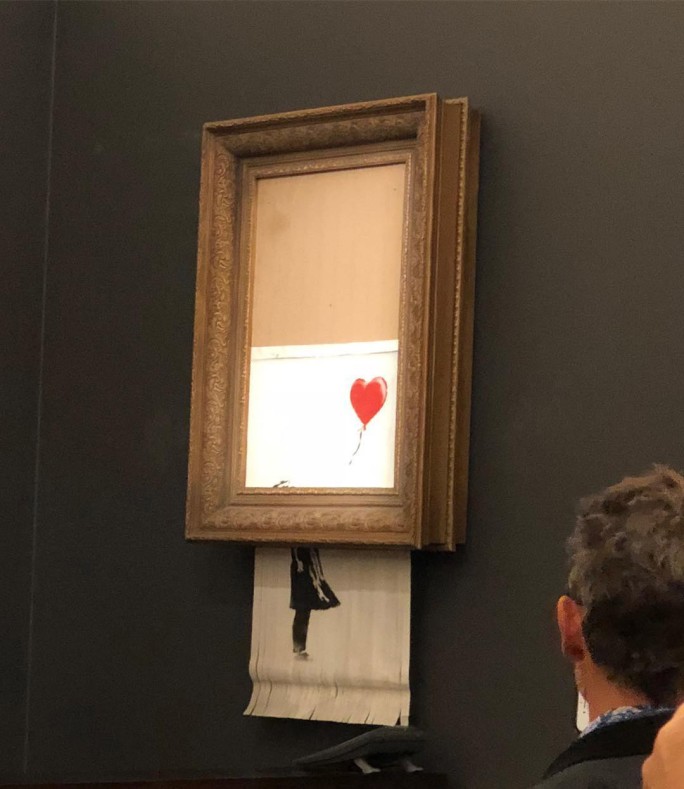
The self-destruction of “Girls with the ball” Banksy immediately after the sale at Sotheby’s. Photo: Sotheby’s

“The Girl with the Ball” is one of the favorite motifs of Banksy, but the large picture in the author’s frame exists in a single copy and was donated by the artist to the owner in 2006, immediately after the Barely Legal exhibition in Los Angeles. He put it at Sotheby’s with an estimate of £ 200–300 thousand, and the new owner was ready to pay several times more for it, but immediately after the hammer’s final blow, the unique canvas went through a paper-cutting machine hidden in a frame and ended up spoiled.

On this occasion, the auction house issued an official statement, in which he called the incident a new legend in the art world. True, so far it has not been reported whether the buyer is ready for its sake – and in fact, the work destroyed, to part with a million pounds.

Banksy himself is in the know – he posted on his Instagram page a frame from the auction room at the time of the secret mechanism, which was framed when it’s unknown when.